Mastering the Four Basic Options Orders: Buy to Open, Buy to Close, Sell to Open, and Sell to Close
Published: January 18, 2026 • Options Basics
Tags: bto, btc, sto, stc
Mastering the Four Basic Options Orders: Buy to Open, Buy to Close, Sell to Open, and Sell to Close
If you're new to options trading, the terminology around entering and exiting positions can feel confusing at first. Terms like "buy to open" and "sell to close" aren't intuitive the way "buy" and "sell" are for stocks. But once you understand the four basic order types, everything clicks into place. These four actions define how you initiate or close both long and short options positions.
In this post, we'll break down each one clearly, explain when and why you'd use it, and include simple examples to make it stick.
Why These Order Types Matter
Options are contracts, not ownership of shares. When you trade an option, you're either:
Opening a new position (creating a new contract obligation or right), or
Closing an existing position (eliminating that obligation or right).
The exchange requires precise language to track whether you're establishing a new position or unwinding an old one. That's where the four phrases come in.
The Four Orders Explained
1. Buy to Open (BTO)
You buy to open when you want to initiate a new long position or add to an existing long position.
You're purchasing an option contract that didn't previously exist in your account.
This is how you start most beginner-friendly strategies: long calls (bullish) or long puts (bearish).
You're paying the premium to acquire the right (but not the obligation) to buy or sell the underlying stock at the strike price.
Example: You think Apple (AAPL) will rise, so you buy to open 10 AAPL 200 calls expiring in March. You now have a new long position of +10 contracts.
2. Buy to Close (BTC)
You buy to close when you want to exit or reduce a short position.
You previously sold (wrote) an option and collected premium.
Now you're buying back the same (or identical) option to close the obligation.
This eliminates or reduces your short exposure.
Example: You sold to open 10 AAPL 200 calls (short calls) when the stock was falling. Now AAPL is rallying and you want out. You buy to close those 10 calls, neutralizing the position.
3. Sell to Open (STO)
You sell to open when you want to initiate a new short position or add to an existing short one.
You're writing (creating) a new option contract and selling it to someone else.
You collect premium upfront, but you now have the obligation if the buyer exercises.
Common in income strategies: covered calls, cash-secured puts, credit spreads, iron condors, etc.
Example: AAPL is trading at $195 and you think it won't go much higher. You sell to open 10 AAPL 200 calls, collecting premium. You now have a short position of –10 contracts.
4. Sell to Close (STC)
You sell to close when you want to exit or reduce a long position.
You previously bought an option (long).
Now you're selling it back into the market to capture profit or cut losses.
This is how most retail traders close winning or losing long options trades.
Example: You bought to open those 10 AAPL 200 calls when the stock was $190. Now it's $210 and the calls have tripled in value. You sell to close to lock in the gain.
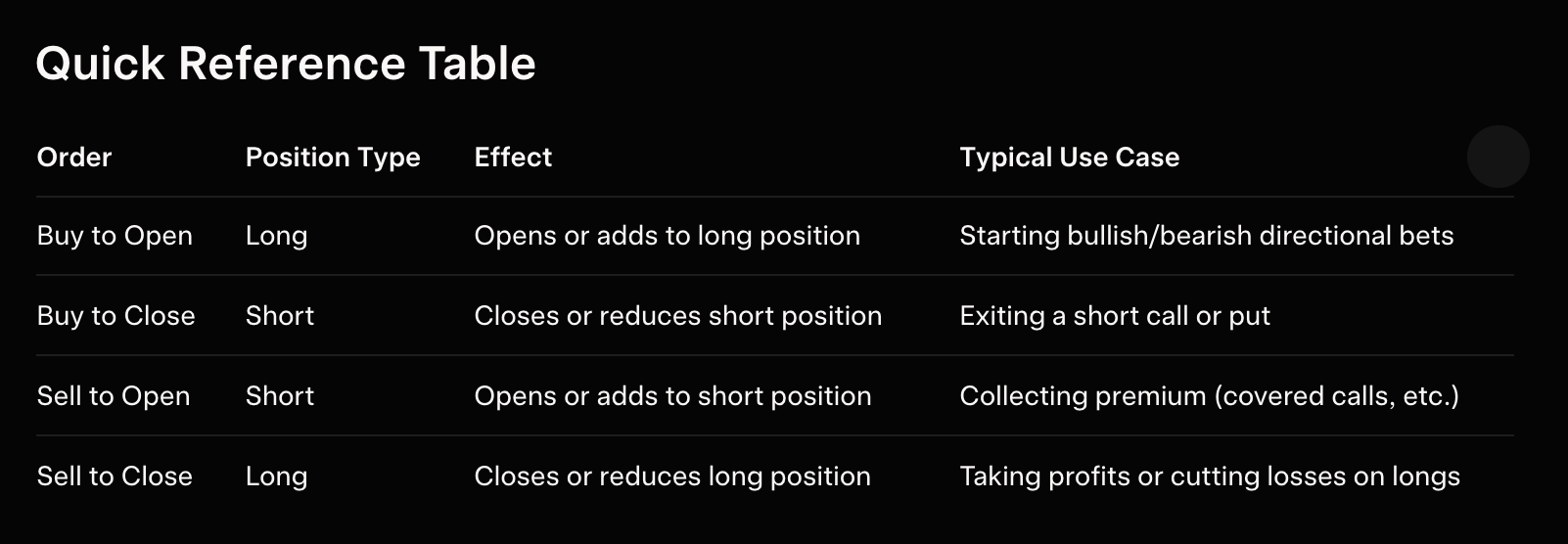
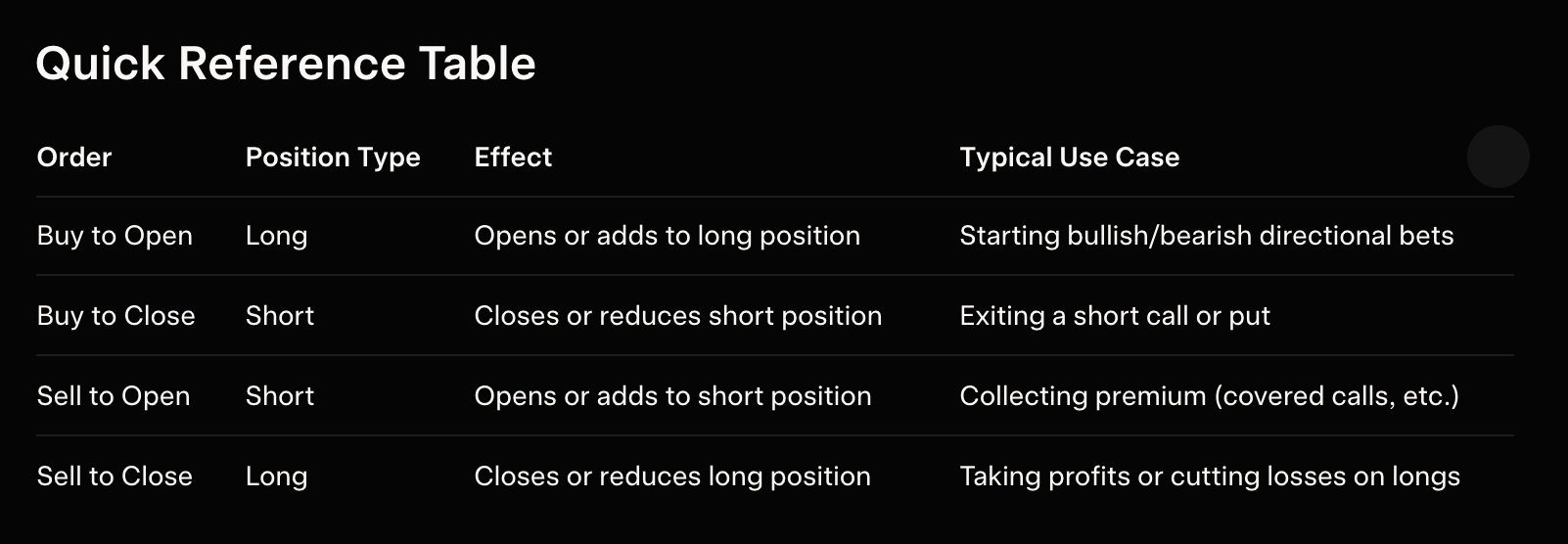
Quick Reference Table
Common Mistakes to Avoid
Using the wrong order type – Accidentally buying to open when you meant to buy to close (or vice versa) can double your position instead of closing it.
Forgetting your current position – Always check whether you're already long or short before placing an order.
Mixing up stock and options habits – In stocks, "sell" always means reducing a position. In options, "sell" can mean opening a new short position.
Final Thoughts
Mastering these four order types is one of the first real "aha" moments in options trading. Once they make sense, strategies like spreads, straddles, and iron condors become much easier to execute confidently.
The key takeaway:
"Buy" is always for long positions (opening or closing).
"Sell" is always for short positions (opening or closing).
"To Open" creates/adds to a position.
"To Close" removes/reduces a position.
Practice on a paper trading account, double-check every order ticket, and you'll rarely make a mistake. Happy (and precise) trading!